

Leave this site safely
You can quickly leave this website by clicking the Quick Exit button. To browse this site safely, be sure to regularly clear your browser history.
The Survivor Reentry Project is on an intake pause.
The Survivor Reentry Project (SRP) is currently not accepting new intakes.
Our current grant funding ends on September 30, 2026. Therefore, SRP is preparing for the possibility that services may pause or close when the current grant ends.
We understand this news may be disappointing and unexpected for survivors and community partners. Our team is actively navigating this transition and remains committed to supporting currently enrolled survivors and placing as many pending cases as possible before the end of the grant.
If additional funding becomes available in the future, we will announce updates regarding program reopening and future intake availability on this page.
We deeply appreciate the trust survivors, advocates, attorneys, and community partners have placed in SRP over the years.
The Survivor Reentry Project is not equipped to handle emergencies. If you are currently experiencing a crisis, please contact your case manager or the National Human Trafficking Hotline.
The hotline can be reached:
By phone: 1-888-373-7888
By email: help@humantraffickinghotline.org
By text: text HELP to 233733 (BEFREE)
Online chat: www.humantraffickinghotline.org
You can also reach out to one of our FNUSA members in your area for local support.
The Trafficking Survivors Relief Act (TSRA) was signed into law on January 23, 2026. FNUSA’s Survivor Reentry Project is working with partners around the US to begin implementation of the law as soon as possible. For more information about the TSRA, read our
TSRA Summary and Analysis
or FAQs about Federal Criminal Record Relief for Human Trafficking Survivors.
The Survivor Reentry Project (SRP) is the only national program that provides post-conviction criminal record relief for human trafficking survivors by connecting them to a nationwide network of pro bono lawyers.
SRP staff also provides training and technical assistance to ensure survivors receive trauma-informed, culturally responsive legal representation, and expand survivors’ access to criminal record relief legal services. SRP works collaboratively with a Survivor Advisory Group, as well as other national training and technical assistance programs, to develop, review, and provide trauma-informed, survivor-centered training and materials to attorneys, advocates, judges, prosecutors, law enforcement, universities/law schools, and legislators.
Please note that SRP does not provide criminal defense for open warrants or open charges. SRP is only able to assist with cases that already have a disposition.
Frequently Asked Questions
What is criminal record relief?
Criminal record relief refers to the legal processes that reduce, seal, expunge, vacate, or otherwise change the impact of a criminal record. Almost all US states now have specific vacatur or expungement laws for survivors of human trafficking whose criminal records are tied to their trafficking experience. You can get more than one kind of relief, and for most survivors the best outcome is both vacatur and expungement.
The different types of relief include:
- Vacatur of Records: The previous judgment of a conviction is nullified. The Survivor can say that they have not been convicted of a crime. The arrest record may still be available to the public.
- Expungement: Legal record of an arrest or a criminal conviction is removed from all public records.
- Sealing: The record (and the conviction or arrest) still exists, but it’s hidden from public view. Law enforcement agencies may still be able to see these records, but employers and landlords should not be able to.
What is human trafficking?
Federal law defines a ‘severe form of trafficking in persons’ as:
Sex Trafficking: The recruitment, harboring, transportation, provision, obtaining, patronizing, or soliciting of a person for the purpose of a commercial sex act which is induced by force, fraud, or coercion, or in which the person induced to perform such act has not attained 18 years of age; or
Labor Trafficking: The recruitment, harboring, transportation, provision, or obtaining of a person for labor or services, through the use of force, fraud, or coercion, for the purpose of subjection to involuntary servitude, peonage, debt bondage, or slavery.
Essentially, it is when a person believes that they have no options and must do work someone is telling them to do because they believe that they will suffer some form of abuse if they do not. It happens in almost every type of work and workplace, including agriculture, manufacturing, hair and nail salons, county fairs, home medical care, child care, home and commercial cleaning, sexually oriented businesses, and commercial sex work. Read more about human trafficking here.
What does SRP do for survivors?
Freedom Network USA’s Survivor Reentry Project (SRP) provides criminal record relief to survivors of human trafficking who have records in more than one state. SRP helps survivors get their full record, understand which records are eligible for relief, and works to match survivors with pro bono attorneys who will file their case.
How can lawyers and service providers partner with SRP?
SRP is seeking partners, including:
Community providers to address survivors’ immediate and ongoing needs. Services include:
- Short and Long Term Housing
- Education Scholarship Opportunities
- Mental Health and Counseling
- Health care
- Employment and Job Skills Training
- Substance Abuse Treatment
Read the SRP Community Partner Outreach flyer.
Pro bono attorneys for representation in Criminal Record Relief to file appropriate motions/petitions for all eligible records in their jurisdiction.
The need is especially acute for lawyers who practice in: AL, AZ, CA, CO, FL, GA, HI, IL, LA, MO, MS, NM, NV, OR, TN, TX, and WA.
What happens to my information?
Your request and information will be kept private. You can view our confidentiality agreement here.
Our team will contact you to talk about your situation in private and explain the different ways we might be able to assist you.
How long will this process take?
The screening and intake process will take approximately 3 to 6 weeks to complete.
Assigning a legal team and clearing records can take anywhere from 6 months to 2 years or longer depending on where the records are located.
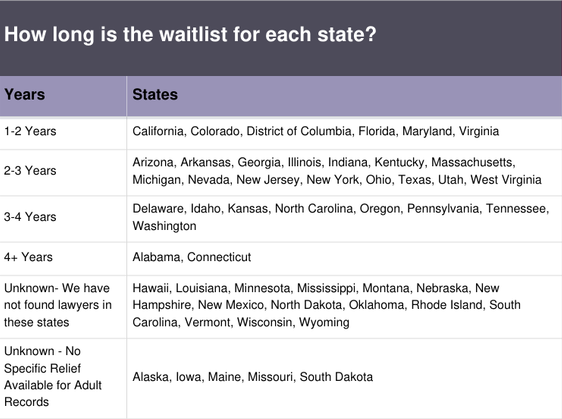
Where can I find help with other issues?
You can contact the National Human Trafficking Hotline or search their directory of providers here for many different types of providers including housing, legal, and social services.
You can find the list of Freedom Network USA members here.
You can find nonprofit immigration agencies here.
You can find civil legal aid agencies, which may provide immigration, family law, employment law, and other types of legal services here.
Eligibility for the Survivor Reentry Project
These services are offered for free to all eligible survivors.
The eligibility requirements are:
- Must be at least 18 years old
- Survivor of human trafficking (Labor, Sex, or Both) which occurred inside the US or a US territory
- Post-conviction matters in more than one state or jurisdiction, if you have criminal records in only one state, please contact a local human trafficking service provider for assistance.
SRP does not provide support for any open or outstanding cases.
Currently, our screening calls and intake are paused. Learn more
Survivor Representation Process for Survivor Reentry Project
Clearing criminal records can be a long and complex process. We agree that it should be easier and faster, but it is not. FNUSA is committed to transparency, we want to be honest with you about the limitations of our project, so that you can make informed choices every step of the way. You can pause the process at any time, for any reason, and come back when you are able. We will do our best to keep you updated and to give you accurate information at all times. Below are the detailed steps of our process, and an expected timeline for each step.
1. Submit Request
Survivors can connect with SRP to schedule a screening call by filling out the Screening Call Request Form by themselves or with the assistance of a service provider. Currently, SRP is on an intake pause. Learn more
Submit general questions or request for information or technical assistance using the Technical Assistance Request Form.
If you are a professional assisting a survivor with the screening request, please use the Screening Call Request Form so that we are capturing the correct information. Currently, SRP is on an intake pause. Learn more
2. Screening
Once the form has been received, the SRP Advocate will reach out via email to schedule a Screening Call with the Survivor or coordinate a call with the professional who completed the form on the Survivor’s behalf (if requested). The purpose of the Screening Call is to ensure that the Survivor is eligible for SRP services, to describe the process, and to answer any questions.
The Screening Call will take about 5-15 minutes. SRP will provide an interpreter, at no cost to the Survivor, if English is not their preferred language.
You can preview the questions here.
The SRP Advocate will then send information about the next steps. Read the Next Steps After the Screening Call flyer.
3. Fingerprints
Once eligibility has been determined, the SRP Advocate will provide the Survivor with instructions on how to obtain a complete criminal records check through a national fingerprinting service at no cost to the survivor. The Survivor must download the report within 72 hours of receipt and email it to the SRP Advocate.
Read Completing the Fingerprint Process with SRP flyer.
If the Survivor already has a copy of their national criminal records check that is up to date, SRP will review those documents and determine if a new report is needed.
4. Intake
Once the criminal records report is received, the SRP Advocate will connect the Survivor with their assigned Pro Bono Intake Team via email.
The Pro Bono Intake Team will schedule an initial call with the Survivor to introduce themselves, explain their roles, and review the Consultation Agreement that outlines what the Survivor can expect while working with the Pro Bono Intake Team.
Next, the Pro Bono Intake Team will schedule an Intake Call with the Survivor to discuss elements of the Survivor’s trafficking experience. This information is used to analyze the Survivor’s criminal record and determine what is eligible for post-conviction relief. Read the Intake Call Questions.
The Intake Call can last up to one (1) hour to complete. Please note that the intake process may take more than one conversation. This is completely normal and allows the Pro Bono Intake Team to move at a pace that feels comfortable for the Survivor. The Pro Bono Intake Team will provide an interpreter, at no cost to the Survivor, if English is not their preferred language. Read the Preparing for the SRP Intake flyer.
5. Strategy Memo
After the Intake is completed, the Intake Pro Bono Team will use the intake interview answers, the relevant state statutes, and the Survivor’s fingerprint results to assess the Survivor’s full record for eligibility. This analysis will be documented in a short memo that explains what is eligible for relief, what may be eligible for general expungement, and what is not eligible at all at the time. Once the Eligibility Memo is complete, the SRP Advocate will coordinate with the Intake Pro Bono Team and the Survivor to schedule an Intake close out call with the Intake Pro Bono Team, the Survivor, and SRP staff. During this call, the team will review the Eligibility Memo with the Survivor, answer any questions, and then SRP will discuss next steps with the Survivor.
6. Assign Legal Team
Assigning a legal team for representation is unfortunately the longest wait period for most Survivors working with SRP. Due to high demand, low capacity of current providers, legal deserts in some states, and the ongoing nonprofit funding cuts, we are working as hard as we can to place cases with legal professionals that are able to provide trauma-competent and survivor-centered representation at no cost to Survivors.
SRP will assign representation as soon as possible. For Survivors with records in multiple states, there will likely be a different lawyer for each state, and they will each be assigned when they are found.
Once SRP has identified a lawyer willing to take a case for representation, SRP will send basic information (Survivor name, date of birth, and contact information; Trafficker name(s) if known; location of the cases) to the lawyer to do a “conflicts check.” This is a required step to make sure that the lawyer has not worked with the Trafficker or has any kind of ethical conflict in the case.
Next, the SRP Advocate will send an introduction email to connect the Survivor with their representation team. SRP will remain involved with both the lawyer(s)–to ensure the legal team has documents and technical support as needed — as well as the Survivor—to help bridge any communication gaps or concerns the Survivor might have while working with the team.
The Survivor can contact SRP at any time for support, to ask questions, or to get additional information.
Read the Tip Sheet for Survivors of Human Trafficking Working with Attorneys flyer.
7. Clear Records
Generally, representation on criminal record relief cases can take anywhere from 6 months to two years depending on how complex the record is and how communicative both the Survivor and legal team are. Most states do not require a hearing with the Survivor present, but some do. To see what each state requires for criminal record relief, please see the SRP Map. Once relief has been granted, SRP will provide the Survivor with any documents that the representation team had not yet provided and close out that state case. If the Survivor has other state cases those cases will remain open until all records are cleared.
Request an A Screening Call (Survivors)
If you are a survivor of human trafficking who has a criminal record and would like to determine if you are eligible for record relief, please complete this form to request a screening call. Our team will reach out to do a confidential assessment and review the options available to you.
Currently, SRP is on an intake pause. Learn more
Professionals
The Survivor Reentry Project provides individualized support, training, consultation, and technical assistance on post-conviction criminal record relief for survivors of human trafficking. Resources are available to attorneys, advocates, judges, law enforcement, universities/law schools, and legislators.
SRP is seeking partners, including:
Community providers to address survivors’ immediate and ongoing needs, including:
- Short and Long Term Housing
- Education Scholarship Opportunities
- Mental Health and Counseling
- Health care
- Employment and Job Skills Training
- Substance Abuse Treatment
Read the SRP Community Partner Outreach flyer.
Pro bono attorneys for representation in Criminal Record Relief to file appropriate motions/petitions for all eligible records in their jurisdiction.
The need is especially acute for lawyers who practice in: AL, AZ, CA, CO, FL, GA, HI, IL, LA, MO, MS, NM, NV, OR, TN, TX, and WA.
Technical Assistance and Intake Request (Professionals)
Request technical assistance here.
Request an assessment for a survivor. Currently, SRP is on an intake pause. Learn more
Criminal Record Relief Laws for Survivors
Post-conviction relief laws vary significantly by state and territory. Click on your state below for an analysis of the law. Click on the list to see links for all states and territories of the US.
Alabama
Alaska
American Samoa
Arizona
Arkansas
California
Colorado
Commonwealth of Northern Mariana Islands
Commonwealth of Puerto Rico
Connecticut
Delaware
District of Columbia
Federate States of Micronesia
Florida
Georgia
Guam
Hawaii
Idaho
Illinois
Indiana
Iowa
Kansas
Kentucky
Louisiana
Maine
Maryland
Massachusetts
Michigan
Minnesota
Mississippi
Missouri
Montana
Nebraska
Nevada
New Hampshire
New Jersey
New Mexico
New York
North Carolina
North Dakota
Ohio
Oklahoma
Oregon
Pennsylvania
Republic of Marshall Islands
Republic of Palau
Rhode Island
South Carolina
South Dakota
Tennessee
Texas
U.S. Virgin Islands
Utah
Vermont
Virginia
Wake Island Atoll
Washington
West Virginia
Wisconsin
Wyoming

Contact Us
For more information about the Survivor Reentry Project, email survivorreentry@freedomnetworkusa.org